
Why Plantar Fasciitis Exercises Are the First Step to Fixing Heel Pain

Plantar fasciitis exercises are one of the most effective ways to relieve the stabbing heel pain that makes your first steps in the morning feel unbearable. If you’re dealing with chronic foot pain, here’s a quick look at the exercises that help most:
- Calf stretch — loosens the tight muscles that pull on your heel
- Towel stretch — gently lengthens the plantar fascia before you get out of bed
- Toe extension stretch — relieves tension at the heel attachment point
- Towel scrunches — strengthens the small muscles supporting your arch
- Marble pickups — improves toe and foot muscle control
- Single-leg heel raises — the most powerful exercise for long-term recovery
Plantar fasciitis is one of the most common causes of foot pain in adults, responsible for around 15% of all foot pain complaints. It affects roughly 1 in 10 people over their lifetime — and if you’re a runner, your risk is even higher.
The pain comes from the plantar fascia, a thick band of tissue running along the bottom of your foot. When it’s overloaded — through repetitive activity, tight calf muscles, or sudden increases in training — it develops tiny tears and becomes inflamed at the heel.
The good news? Most people recover fully. Around 80% of people with plantar fasciitis report no pain within one year of treatment. And the right exercises can get you there faster.
This guide walks you through exactly which exercises to do, how to do them, and how to combine them with other treatments for the best results.
What is Plantar Fasciitis and What Causes It?
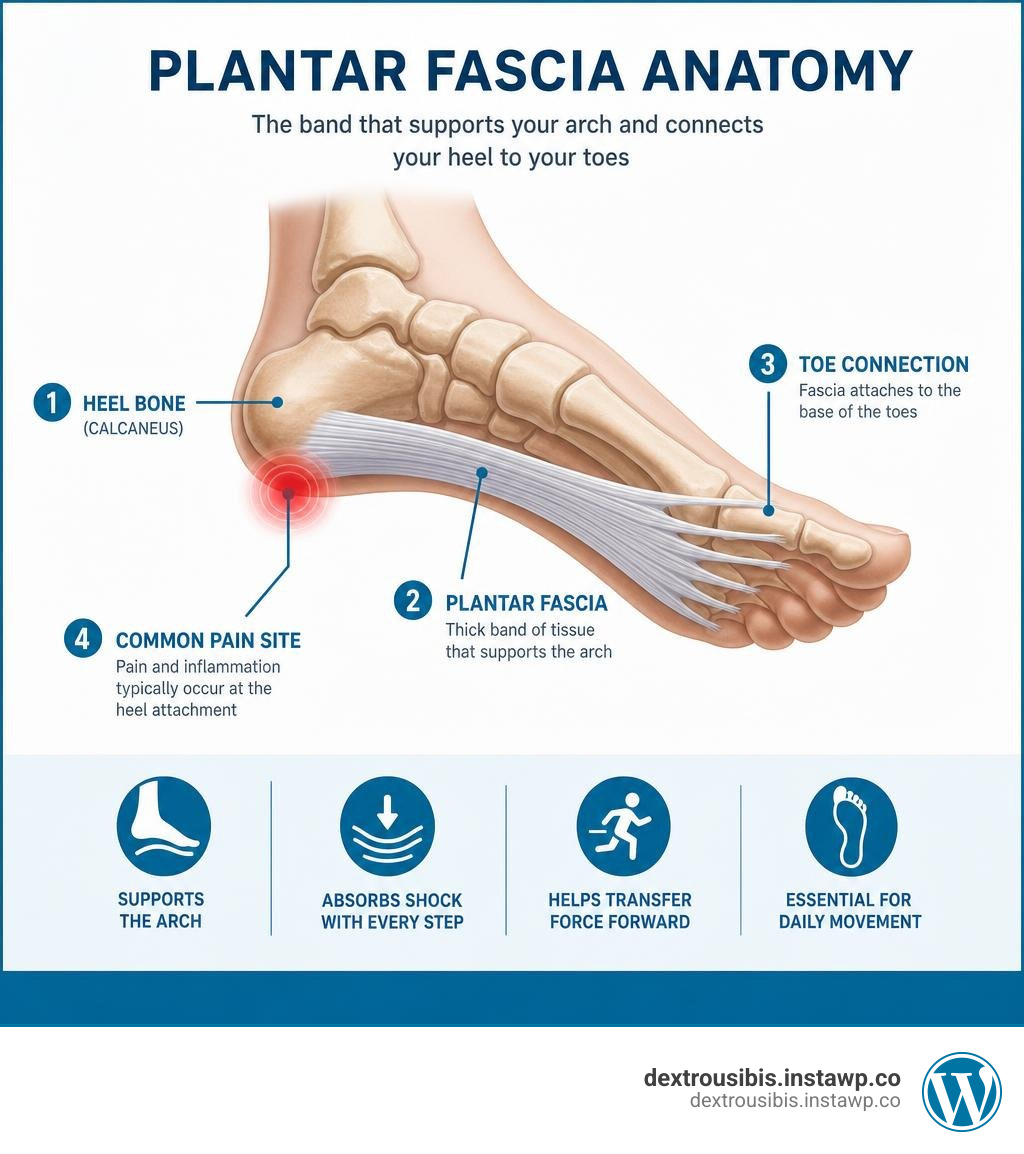
To fix your heel pain, it helps to understand what is actually happening inside your foot. The plantar fascia is a thick, rubber-band-like ligament that runs along the sole of your foot, connecting your heel bone (calcaneus) to the base of your toes. Its primary job is to act as a shock absorber and support your foot’s arch every time you take a step.
When you walk or run, a mechanical process called the windlass mechanism takes place. As your big toe bends upward, it winds the plantar fascia around the joint, shortening the band and naturally packing your arch into a rigid, stable structure.
However, when the load placed on this system exceeds its capacity to adapt, the tissue suffers repetitive microtrauma. Over time, this leads to tiny tears, disorganized tissue fibers, and localized swelling. While traditionally referred to as an inflammatory condition (hence the “-itis” suffix), modern medical research classifies chronic cases as a tendinopathy (often called plantar fasciopathy). Because the tissue is largely avascular (having a limited blood supply), it does not heal easily through simple rest.
Several key risk factors contribute to this condition:
- Tight calves (gastrocnemius and soleus muscles): Your calf muscles connect directly to your Achilles tendon, which wraps around the back of your heel and merges with the fibers of the plantar fascia. If your calves are tight, they constantly pull on the heel bone, keeping the plantar fascia under extreme, structural tension.
- Overuse and sudden training spikes: Rapidly increasing your walking or running mileage, or spending long days standing on hard surfaces, can overload the tissue.
- Foot mechanics and genetics: Natural foot structures, such as very high arches or flat feet, alter how weight is distributed across your sole.
- Footwear choices: Wearing shoes that lack proper arch support or regular use of high heels can keep the calf and fascia in shortened, vulnerable positions.
The Best Plantar Fasciitis Exercises for Pain Relief
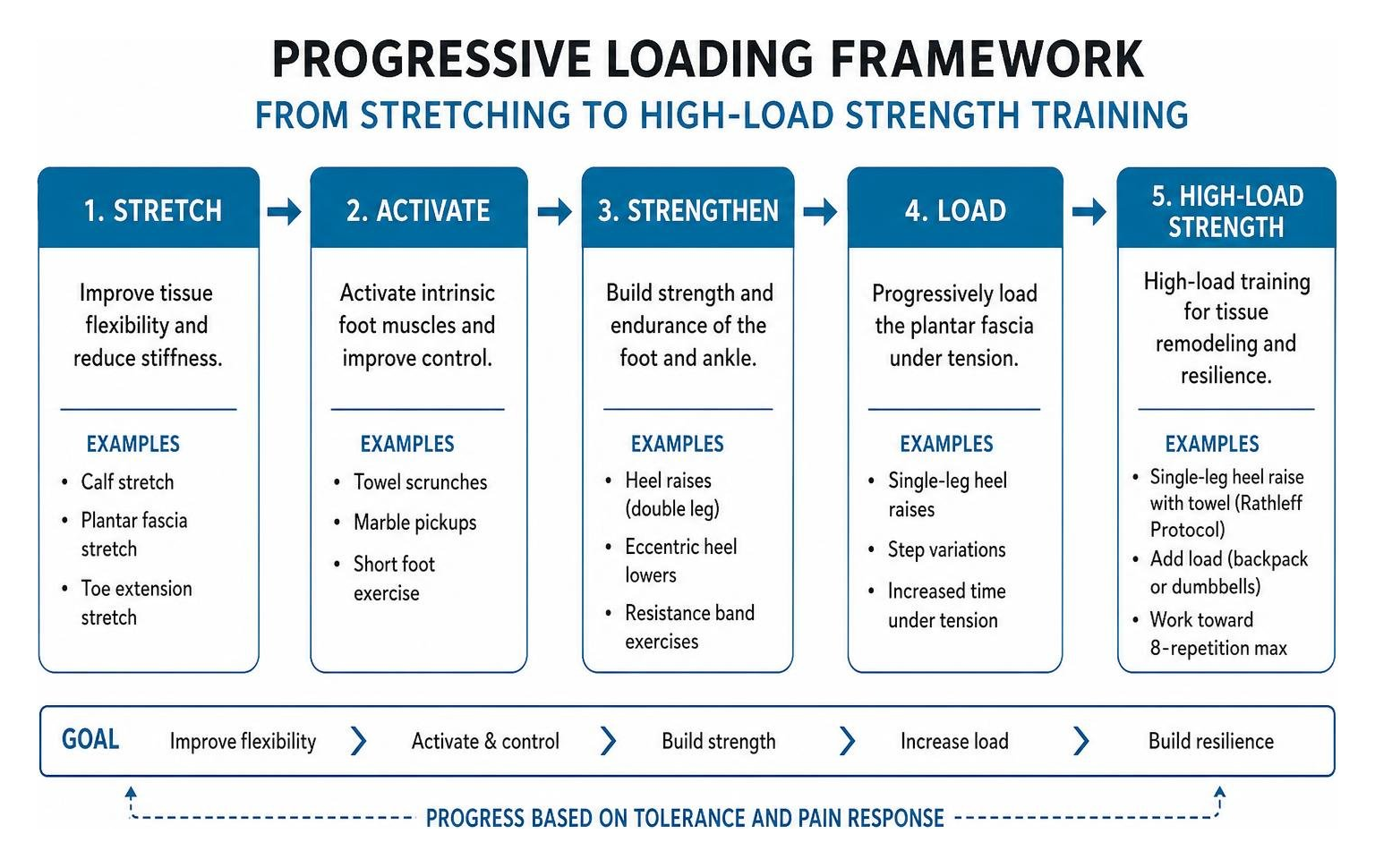
When it comes to treating plantar fasciitis, we focus on two primary physical therapy goals: improving tissue flexibility to reduce immediate tension and building strength to handle future loads.
While resting completely might seem tempting, it actually causes the fascia to contract and tighten further. Appropriate, managed physical activity is the real key to recovery.
To help you understand the dual approach to recovery, let’s compare traditional stretching with modern high-load strength training:
| Feature | Stretching Exercises | High-Load Strength Training |
|---|---|---|
| Primary Goal | Lengthen tight tissues and reduce immediate tension | Stimulate collagen remodeling and build load tolerance |
| How it Works | Passive holding of the calf and plantar fascia | Active, loaded movement under tension (Windlass position) |
| Typical Frequency | Daily (often multiple times per day) | Every second day |
| Key Study Result | Provides reliable, short-term pain relief | Scored 29 points lower on the Foot Function Index at 3 months |
Essential Stretching Plantar Fasciitis Exercises
Stretching is the cornerstone of early pain management. By relaxing the calf muscles and the Achilles tendon, you immediately take the mechanical “tug-of-war” pressure off your heel.
Here are the most effective daily stretches to integrate into your routine, designed to improve overall flexibility. For more details on these movements, you can explore the Cleveland Clinic guide on stretches or check out the Oxford Health exercises.
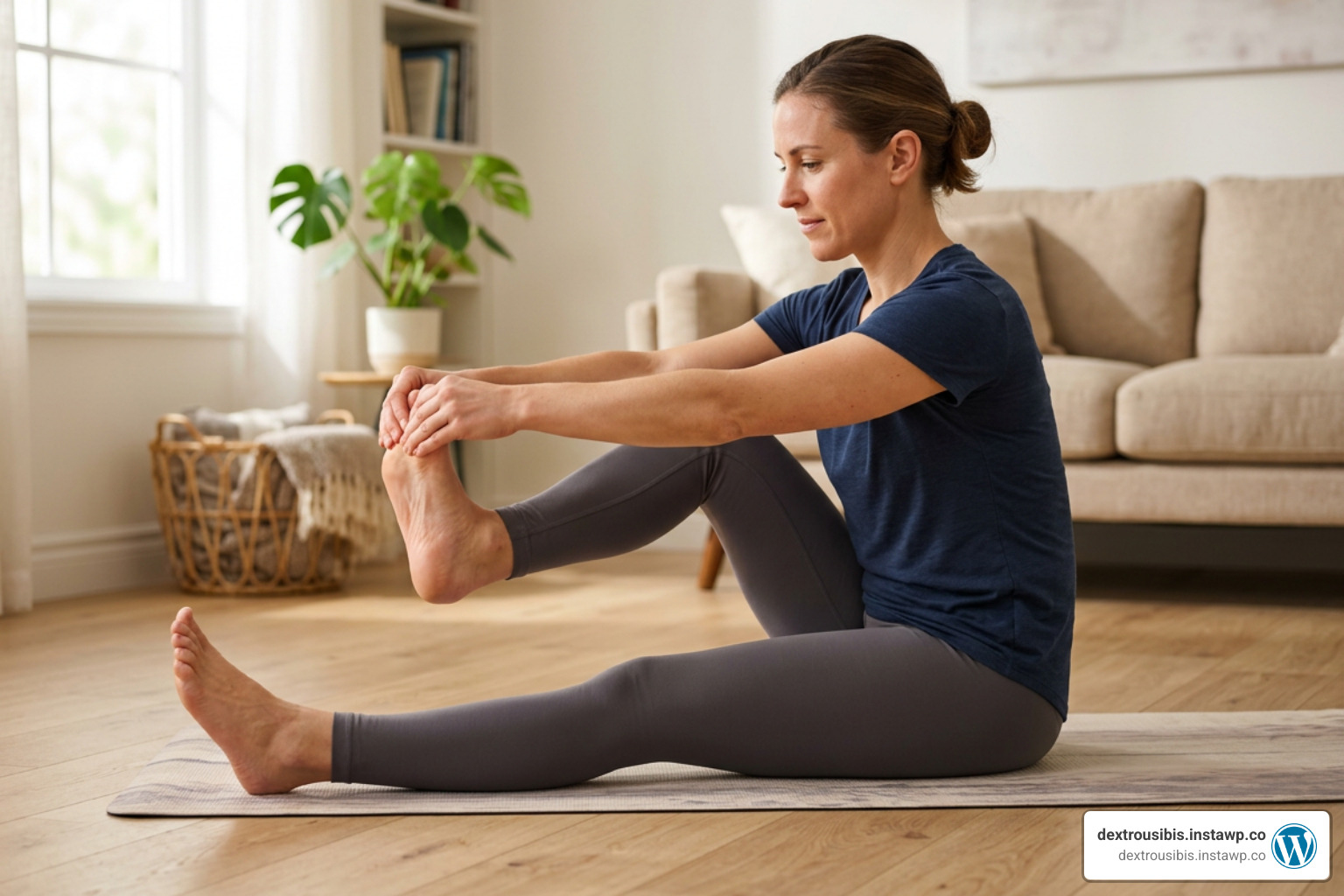
- The Pre-Out-of-Bed Towel Stretch: Before your feet even touch the floor in the morning (when the fascia is cold and contracted), sit up in bed with your leg straight. Loop a towel around the ball of your foot and gently pull it toward you. Keep your knee straight and hold for 30 seconds. Repeat 3 times per foot.
- The Seated Toe Extension Stretch: Cross your affected leg over your other thigh. Grasp your toes (especially the big toe) and pull them back toward your shin until you feel a stretch in your arch. At the same time, use your other hand to massage the sole of your foot. Hold for 10 seconds, repeating for 2 to 3 minutes, 2 to 4 times a day.
- The Standing Calf Stretch (Wall Push): Stand facing a wall with your hands flat against it. Step your painful foot back, keeping the knee completely straight and the heel firmly planted on the floor. Bend your front knee and lean forward until you feel a deep stretch in your back calf. Hold for 45 seconds. Repeat 3 times, 4 to 6 times a day.
- The Calf Stretch on a Step: Stand on the bottom step of a staircase with the balls of your feet on the edge. Slowly lower your heels down past the step until you feel a stretch in your calves and Achilles tendon. Hold for 15 to 30 seconds, then gently bring your feet flat again. Repeat 3 times.
Strengthening Plantar Fasciitis Exercises for Long-Term Recovery
Stretching makes the tissue more compliant, but strengthening makes it resilient. By targeting the intrinsic muscles of the foot (the tiny muscles inside your arch), you build a better built-in support system.
To learn more about the science behind foot muscle rehabilitation, refer to the NCBI Book on foot exercises.
- Towel Scrunches: Sit in a chair with your bare foot resting on a flat towel placed on a hard floor. Using only your toes, curl and scrunch the towel toward your heel. Repeat this 10 times, 1 to 2 times a day. To make this harder as you progress, place a small weight (like a soup can) on the far end of the towel.
- Marble Pickups: Place a handful of marbles on the floor next to a small cup. Use your toes to grab one marble at a time, lift it up, and drop it into the cup. Repeat this for 8 to 12 marbles, once or twice daily. This is excellent for coordination and activating the deep arch stabilizers.
- Ice Massage Arch Rolls: While technically a mobilization exercise, rolling your foot over a firm, cold object helps desensitize painful nerve endings while working the tissue. Roll your arch back and forth over a frozen water bottle or a tennis ball for 3 to 5 minutes, twice a day.
High-Load Strength Training vs. Stretching
For years, passive stretching was the only recommended therapy. However, a landmark 2015 randomized controlled trial (RCT) changed the conversation entirely. The study compared simple stretching to a specific high-load strength training program (often called the Rathleff Protocol).
The results were striking: at the 3-month mark, patients using high-load strength training scored 29 points lower on the Foot Function Index (indicating much better function and less pain) compared to those who only stretched.

Why does it work so well? High-load training forces the plantar fascia to undergo “progressive loading” while stretched. This mechanical tension stimulates collagen remodeling, essentially rebuilding the disorganized fibers into a stronger, more organized structure.
Here is how to perform the Rathleff Protocol:
- The Setup: Stand on the edge of a step with your heels hanging off. Place a rolled-up towel under your toes on the affected foot. This towel is critical because it forces your big toe into extension, activating the windlass mechanism and pre-tensioning the fascia.
- The Movement: Perform a single-leg heel raise. Take 3 seconds to rise up onto your toes, hold the top position for 2 seconds, and then take 3 seconds to slowly lower your heel back down below the step level.
- The Protocol: Perform 3 sets of 12 repetitions every second day.
- Progression: Once you can easily complete 12 repetitions without pain, add weight. You can do this by wearing a backpack filled with books or holding light dumbbells, gradually progressing to an 8-repetition maximum (using more weight for fewer reps).
These progressive loading frameworks align closely with the APTA clinical practice guidelines, which strongly emphasize combining stretching with progressive strengthening rather than relying on stretching alone.
Combining Exercises with Other Effective Treatments
While plantar fasciitis exercises are highly effective, they work best when integrated into a comprehensive, multimodal treatment plan. Combining loading exercises with supportive, passive therapies helps protect your feet throughout the day.
- Night Splints: When we sleep, our feet naturally relax into a pointed-down position, causing the plantar fascia to shorten and tighten overnight. This is why those first morning steps are so painful! Wearing a night splint holds your ankle at a neutral 90-degree angle, keeping the calf and fascia gently stretched while you rest.
- Orthotics and Footwear: Sturdy, supportive shoes with a cushioned heel and adequate arch support are essential. Avoid going barefoot, even at home. Over-the-counter or custom foot orthoses can temporarily distribute pressure away from the painful heel.
- Athletic Taping: Using non-elastic sports tape to create a supportive “sling” under your arch (antipronation taping) can provide immediate, short-term relief, especially during acute flare-ups. This support can safely be left on for up to 48 hours.
- Manual Therapy: Working with a professional for soft tissue mobilization, such as myofascial trigger point release or instrument-assisted soft tissue mobilization, can help relax tight calf muscles and improve ankle mobility.
If you are looking for specialized, local care in Tucson, Arizona, we highly recommend exploring The Dr. Larsen Difference: Exploring Top Podiatry Care to see how custom, comprehensive treatment plans can accelerate your healing.
Frequently Asked Questions about Plantar Fasciitis
When should I seek medical evaluation instead of relying on exercises alone?
While conservative home care is the starting point for most, certain “red flag” symptoms mean it is time to put the exercises on hold and seek a professional diagnosis. You should schedule a medical evaluation if you experience:
- Severe, sudden pain after a trauma or fall (which could indicate a heel fracture or acute fascia tear)
- Visible swelling, redness, or heat around the heel and ankle
- Numbness, tingling, or a “burning” sensation that radiates into your toes (which may indicate nerve compression, such as Tarsal Tunnel Syndrome)
- Pain that persists even when resting or wakes you up in the middle of the night
- No noticeable improvement after 4 to 6 weeks of dedicated daily exercises
If you are experiencing any of these symptoms in the Tucson area, you can learn more about professional diagnostic tools and therapeutic options by exploring All Feet Podiatry services.
How long does it typically take to see improvement from exercise-based treatment?
Patience is key. Because the plantar fascia has a limited blood supply, tissue remodeling takes time. While many people experience a reduction in sharp pain within 2 to 4 weeks of starting gentle stretches, a full recovery typically takes 3 to 6 months.
In fact, the 2015 high-load strength training trial showed that only about 6% of participants reached a completely satisfactory, symptom-free state within the first 12 weeks. Most patients require several months of consistent, multimodal care to fully rebuild tissue strength and return to high-impact activities like running without pain. For structured home advice, you can download the Arthritis UK exercise sheet.
How often and for how long should these exercises be performed?
Consistency beats intensity every single time. Stretches should be performed daily — ideally spending at least 10 minutes per day lengthening the calves and feet. We recommend doing your first stretches before getting out of bed, and repeating them after any prolonged periods of sitting.
Strength training exercises, like the Rathleff Protocol heel raises, should be performed every second day to give your muscle fibers and collagen tissues time to rest, adapt, and rebuild. For a detailed breakdown of a progressive loading schedule, review the NHS guide on plantar fasciopathy.
Conclusion
Dealing with plantar fasciitis can be incredibly frustrating, but your body has a remarkable capacity to heal when given the right physical stimulus. By combining daily calf stretches with progressive high-load strength training, you can directly address the root causes of your heel pain, rebuild your foot’s structural resilience, and get back to the activities you love.
Recovery is a gradual process that requires time, consistency, and a proactive approach to foot health. If you are struggling with persistent heel pain in the Tucson, Arizona area, don’t navigate this journey alone. Let us help you find lasting relief. Visit All Feet Podiatry services at dextrousibis.instawp.co to schedule an appointment with our expert team and take your first pain-free step today!
Leave a Reply